NexxosHQ
A multi-tenant operating system for African businesses — HR, tasks, attendance, messaging, and OKRs in one platform, isolated per company at the database level.
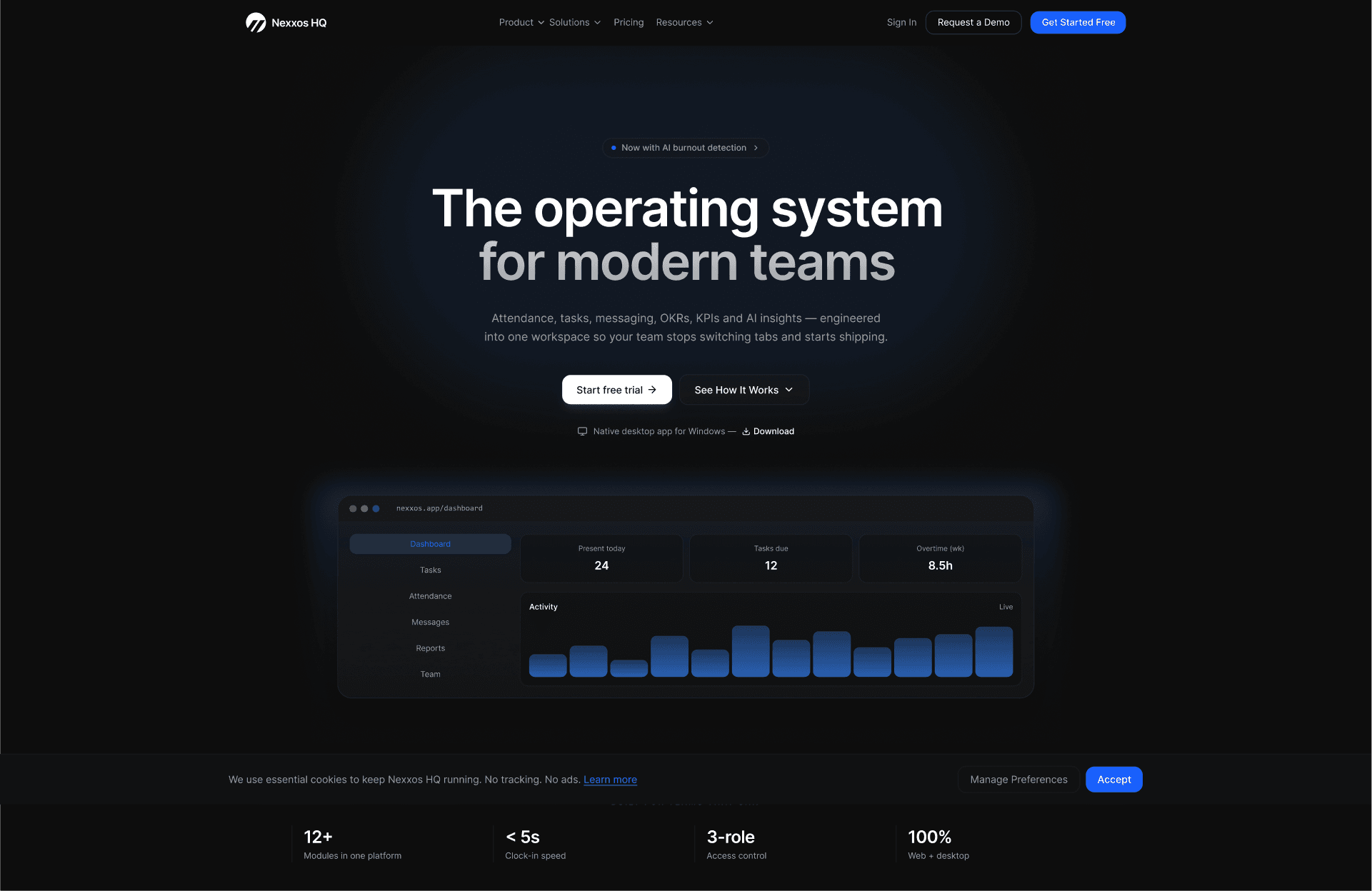
Why it needed to exist.
Growing African businesses run on a scatter of disconnected tools — a chat app here, a spreadsheet for attendance there, tasks in a third place, and nothing that talks to each other. The all-in-one platforms built for Western companies are expensive, over-complicated, and rarely fit how teams here actually operate. I built NexxosHQ as a single operating system where a company runs its people, work, and communication in one place — and where each business's data is provably sealed off from every other's.
How it’s built.
NexxosHQ is a multi-tenant SaaS: one application and one database serve many separate companies, and the hardest requirement is that no organization can ever see another's data. I solved that at the foundation rather than bolting it on. Every table carries an organization identifier, and PostgreSQL Row-Level Security policies enforce that a user's queries can only ever touch rows belonging to their own organization — the isolation lives in the database, so even a bug in application code can't leak data across tenants. Security is a property of the schema, not a promise made by the frontend.
On top of that tenant boundary sits a role and permission layer. Within a company, access is scoped by role — an owner, an admin, and a team member see different surfaces and hold different rights — all enforced server-side through Supabase Auth and RLS policies rather than hidden UI.
The product itself is a set of modules sharing that single secure core: task and project management, attendance, HR records, internal messaging, and OKR tracking, with an AI layer for assistance across them. New organizations onboard through a seeded setup — 60+ department templates — that takes a company from signup to a structured, working workspace in minutes instead of days. The stack is React and TypeScript on the front, Supabase (Postgres, Auth, Storage, Edge Functions) on the back, deployed on Vercel — a lean stack running a genuinely complex system.
Above the tenants is a super-admin dashboard I use to operate the platform itself: provision organizations, monitor usage, and manage the system across every company from one control plane.
The hard parts.
Enforcing tenant isolation at the data layer. The core engineering decision. Rather than filtering by organization in application code — which fails the moment one query forgets the filter — I wrote RLS policies so Postgres itself refuses to return another tenant's rows. Isolation you can't accidentally bypass. Modeling role-based access cleanly. Owners, admins, and members need genuinely different capabilities without the permission logic sprawling across the codebase. I centralized it in the auth and policy layer so every module inherits the same rules consistently. Making onboarding instant. A blank B2B platform is intimidating. I built a seeded setup that provisions 60+ department templates and a working structure on signup, so a new company lands in something usable immediately instead of a wall of empty screens. Many modules, one coherent system. Tasks, attendance, HR, messaging, and OKRs each have their own data and logic, but had to feel like one product. I built them on a shared core and navigation so the whole thing reads as a single operating system, not five stapled-together tools. A super-admin control plane. Operating a multi-tenant platform means managing it above the level of any single company — so I built a separate admin surface to provision and monitor organizations across the entire system.
What shipped.
exxosHQ is live at nexus.skryveai.com, running as a full multi-tenant platform with working HR, task, attendance, messaging, and OKR modules and a super-admin dashboard. It currently serves 50 organizations and 200+ users. I designed and built the entire system solo, including the architecture, security model, every module, and deployment. It's the clearest demonstration of the thing most engineers never get to prove on a personal project: that I can design and ship secure, multi-tenant B2B infrastructure end-to-end.