OUTRIQ
An autonomous AI marketing agent that finds a business its customers across the internet — no ad platforms, no campaigns. A systems-architecture study.
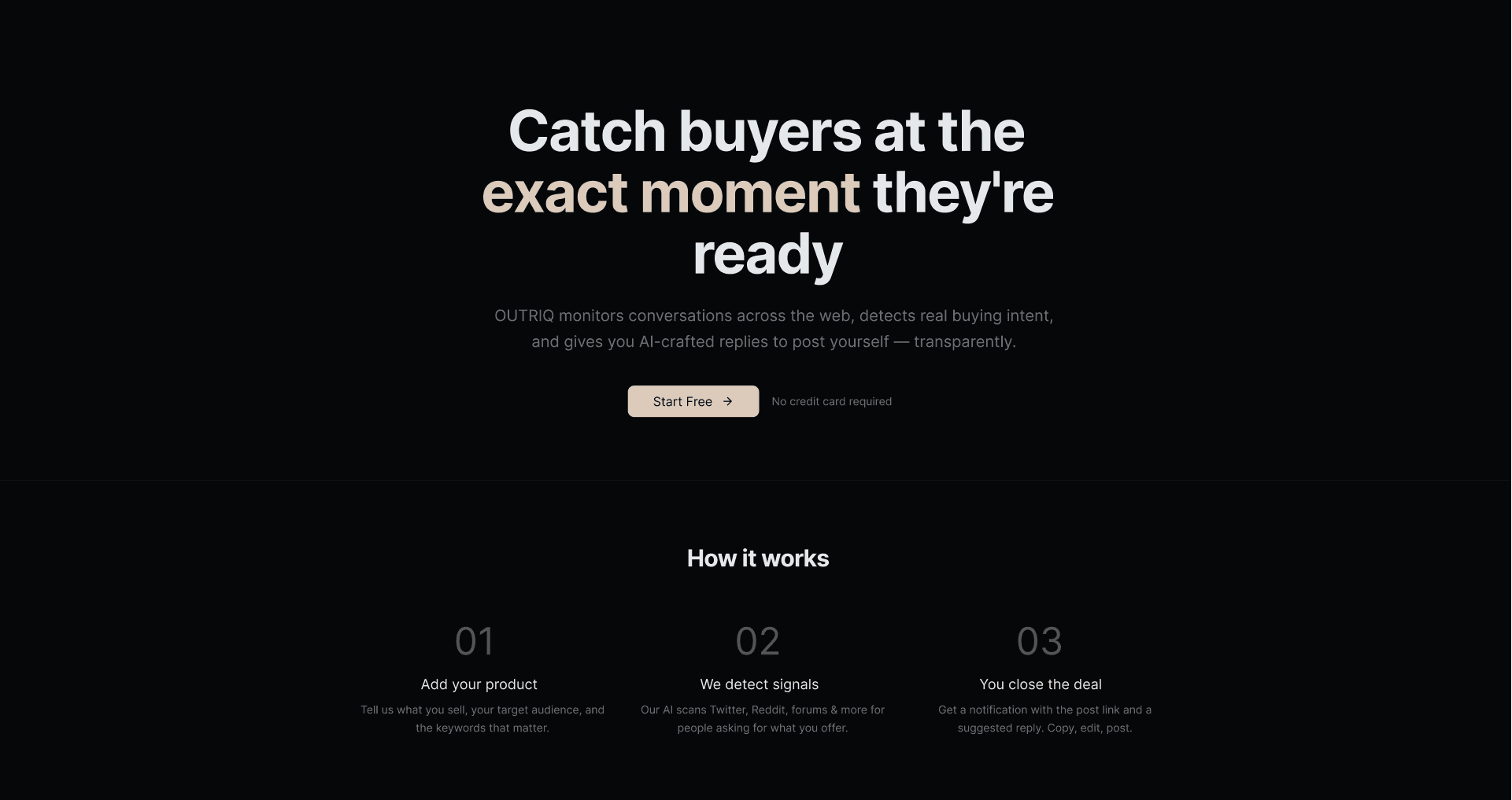
Why it needed to exist.
Small businesses — especially across Africa — are locked out of modern advertising. Reaching customers means paying into Google and Meta's ad monopolies and learning to run campaigns, set budgets, and read dashboards most owners have no time or training for. I wanted to design a system that removes all of it: a business describes its product once, and an autonomous AI agent goes out across the internet, finds the people who are actually looking for it, and puts the product in front of them — a marketing department that runs itself.
How it’s built.
Outriq is designed as a three-layer autonomous system, and the architecture is the work here — this is a study in how you'd actually build a self-running marketing agent, not a wrapper around an ad API.
The first layer is signal detection: continuously scanning the open internet — forums, social platforms, communities — for real-time buying intent, the moments where someone is actively looking for what a business sells. The second layer is understanding and matching: language models interpret each signal, judge fit against the business's product, and decide whether and how to respond. The third layer is autonomous distribution: placing the business in front of that customer at the right moment, in the right place.
The hardest design problem was the human bottleneck — early versions of any such system need a person to watch signals and approve every action, which doesn't scale. I worked through three architectural answers to remove that bottleneck: a Browser Agent Swarm (autonomous agents driving real browsers via Playwright to act in real time), an Owned Surfaces strategy (embeddable recommendation widgets so distribution happens on partner sites the system controls), and a Reverse Signal architecture (consumer-facing tools — WhatsApp bots, directories, comparison tools — that pull demand inward instead of only scraping outward). The full blueprint also covers the database schema, external API integration strategy, platform-compliance approach, and a 90-day MVP roadmap.
The hard parts.
Removing the human from the loop. The core challenge of any autonomous agent: it can't need a person approving every action. I designed three independent architectures to solve it — a Playwright-driven browser agent swarm, owned embeddable surfaces, and demand-pulling consumer tools — each attacking the bottleneck from a different angle. Not a marketplace — an outward agent. The easy version of this idea is a listing site where businesses wait to be found. I deliberately designed the opposite: a system that goes outward across the internet to where customers already are, which is a fundamentally harder and more valuable architecture. Designing for real constraints, not a demo. The blueprint confronts the genuinely hard parts head-on — the cold-start problem, attribution, platform dependence, pricing for a low-margin African market, and multi-language support — rather than hand-waving them. Naming what breaks is part of engineering it. Distribution the system can own. A system that depends on platforms it doesn't control is fragile. I mapped channels Outriq could own outright — WhatsApp-first tools, embeddable widgets, USSD/SMS over African telecom rails — so its reach doesn't rest on someone else's permission.
What shipped.
Outriq exists today as a fully developed concept and technical architecture — a complete blueprint from system design through a 90-day MVP roadmap. I include it not as a shipped product but as the clearest demonstration of how I approach hard, ambitious systems: taking a genuinely novel idea — autonomous, agent-driven marketing — and designing a real, buildable architecture for it, including the parts most people would skip. It's the thinking that comes before the code.